Sampson and the Unfinished Revolution
From Deborah Sampson to Goodridge: how the Massachusetts principles of 1780 kept widening, and why LGBTQ history isn't a scavenger hunt for proof
She fought the Revolution in disguise, and two centuries later the same Massachusetts principles she served under would make us the first state where same-sex couples could marry. A Fourth of July worth spending on the people the speeches leave out.
Every Fourth of July, we tell ourselves the story of the Revolution. Washington, Revere, Adams. Battles won, a declaration signed, a nation talked into being in the name of liberty. It's a good story. It just isn't a complete one.
One of the most extraordinary revolutionaries Massachusetts ever produced almost never makes the speeches.
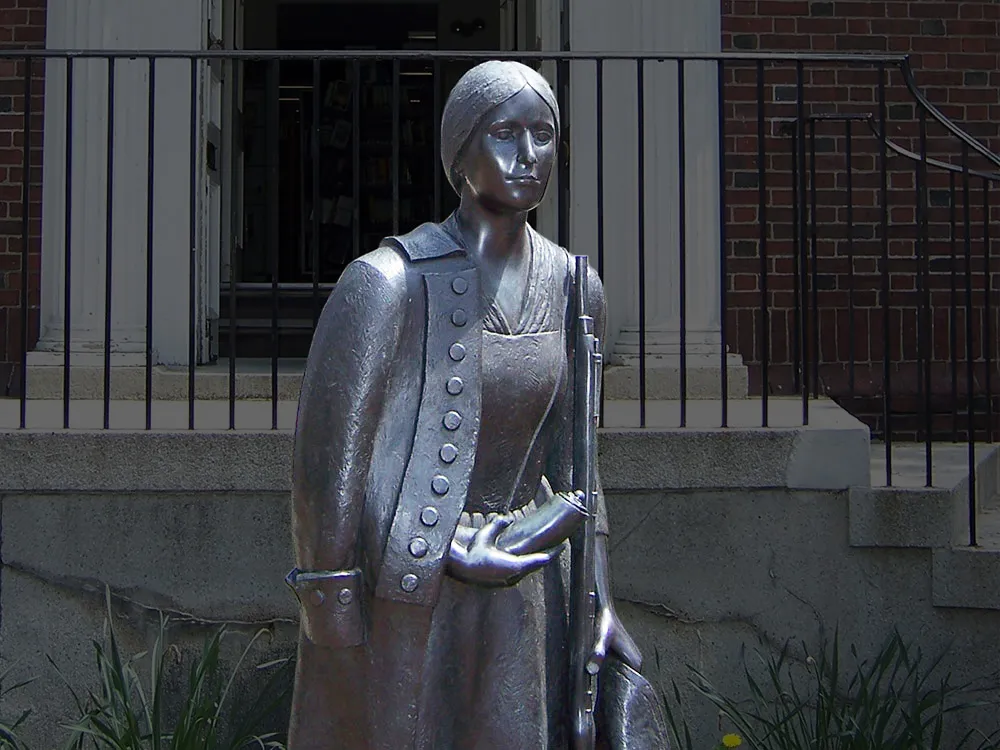
Deborah Sampson wasn't supposed to be there.
She was born in Plympton in 1760, into the kind of poverty that scatters a family. Her father left. Her mother, unable to keep her children together, bound Deborah out as a servant. Women in her world could not vote, could not hold office, and could not enlist. So in 1782 she made herself into someone who could. She cut her hair, bound her chest, borrowed a man's name, Robert Shurtleff, though the spelling wanders from one record to the next, and walked into the 4th Massachusetts Regiment.
She served seventeen months. She marched, she drilled, she fought in skirmishes up the Hudson Valley. When she took a ball to the thigh outside Tarrytown, legend holds she dug it out herself with a penknife rather than let an army surgeon get close enough to learn her secret. The leg never fully healed. She kept marching anyway.
The secret held until a fever did what the British couldn't. Hospitalized in Philadelphia, she was found out by a doctor named Barnabas Binney, who, to his credit, kept quiet and got her home to recover before the news traveled. And here's a detail worth savoring: the general who handed her an honorable discharge at West Point, in October 1783, was Henry Knox. The same Boston bookseller who had dragged sixty tons of cannon down from Ticonderoga and ringed Boston with forts. He said nothing, signed the papers, and gave her money for the road.
That much is history.
Everything after gets wonderfully harder to pin down.
Why did Deborah Sampson enlist?
Patriotism, surely. The war she joined was still the war for the independence promised six years earlier. Money, almost certainly — the army paid, and few things in her life did. But historians keep circling a harder question. What does it mean that someone assigned female at birth chose, not for an afternoon but for a year and a half, to live successfully as a man — and, by more than one account, rather took to it?
The accounts themselves are slippery. Her first biographer, Herman Mann, published a semi-fictionalized life in 1797, full of chaste but charged attachments to women. Sampson's own lecture tour featured a "Baltimore lady" who bought Robert Shurtleff expensive gifts and plainly hoped for something back. Her modern biographer, the historian Alfred F. Young, spent years separating the fact from the embroidery and came away with a life that refuses a tidy caption.
So we're left with the arguments.
Some read Deborah Sampson as a lesbian patriot. Some wonder whether, given the language we now have, we'd recognize something like a transgender life. Others insist she was simply a resourceful woman who put on the only costume that fit the role she needed to play. The record doesn't referee.
And that's fine.
Queer history isn't a scavenger hunt
We tend to approach LGBTQ history like we're hunting for a receipt, some airtight proof that a person was gay or lesbian or trans before we'll let ourselves claim them. History almost never hands over the receipt. The words we use now didn't exist in Sampson's world, and neither did the identities built around them. But people still fell in love where they weren't supposed to. They still slipped the roles they'd been handed. They still crossed lines other people swore were permanent.
Deborah Sampson crossed a few.
That's enough to make her ours. Not as a settled case, but as someone whose life never fit comfortably inside the expectations of her time. Which, if we're honest, is most of the point.
From John Adams to Goodridge
Here's the part I love about her being one of ours, and one of Massachusetts'.
In 1780, John Adams wrote into the Massachusetts Constitution that "all men are born free and equal." Within a few years those words had helped end slavery in the Commonwealth, and the constitution he drafted went on to shape the federal one. Adams was not thinking about Deborah Sampson when he wrote them. He was certainly not thinking about the couples who, more than two centuries later, would line up outside city halls.
But in 2003, in Goodridge v. Department of Public Health, the Massachusetts Supreme Judicial Court reached back to those same principles of liberty and equality and found room in them for same-sex couples to marry. On May 17, 2004, Massachusetts became the first state in the country where we could. Some of us remember the lines outside those city halls that morning.
The promise widened. Not because the words changed. Because our sense of who they covered did.
Deborah Sampson could never have pictured marriage equality. Adams never meant to protect us. That's how it tends to go: the people who write the great lines rarely see everyone the lines will one day hold.
Which is why she belongs in the Fourth of July, and why she belongs in these pages. Not because anyone can hand you a caption for her — lesbian, trans, something with no name yet. We can't. She belongs because she is proof that the argument over who counts as free has never once been finished.
The Revolution didn't end at Yorktown. In Massachusetts, it never quite ends. Every generation it circles back to the same question: who's still standing outside the promise, and whether we've got the nerve to open the door.