‘We would not be here today if it weren’t for Barney Frank’: Gov. Healey’s remarks at the Faneuil Hall memorial
Share this Post:
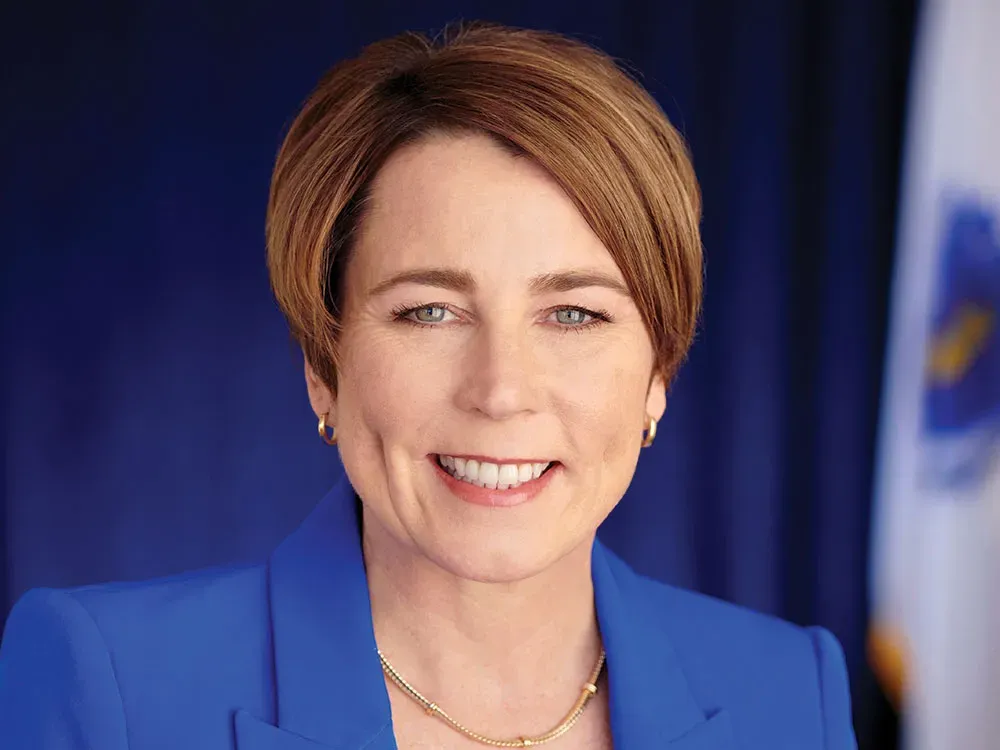
Public domain photo via Wikimedia Commons.
A memorial service for former Congressman Barney Frank, who died May 20 at age 86, was held Monday, June 8, at Faneuil Hall. Hundreds gathered to remember the 16-term congressman, who in 1987 became the first member of Congress to voluntarily come out as gay. Speakers included Gov. Maura Healey, Boston Mayor Michelle Wu, former House Speaker Nancy Pelosi, Congressman Jim McGovern, and Frank’s longtime friend and former State House colleague Jim Segel; former Secretary of State John Kerry and Sens. Elizabeth Warren and Ed Markey were among those in attendance. Below is a portion of Gov. Healey’s remarks, lightly edited for clarity. The full service is available on YouTube: https://www.youtube.com/watch?v=8aPo-XHzGhE.
“I want to say something about the impact that Barney Frank had on me.
I think I was in high school when he came out publicly. I remember something about that, and of course I hadn’t even come out, so it didn’t exactly hit at that time. But I will tell you: years later, when I made a decision to run for office, Barney Frank was the first person I thought of, because I knew that, because of his bravery — and remember, this is the ‘80s. This is not today. This is not the 2000s. This is not the 1990s. This is the 1980s. Barney Frank showed incredible bravery, in my view, to — yes — answer the question posed to him by the reporter: “I’m gay, so what?” What a masterful way to address that.
And then, of course, he went on this incredible career, showing up not just for the gay community but showing up for all of us in so many ways, and becoming such an incredible force, with such an impact on our country. I just want to appreciate the bravery of someone like Barney Frank.
One of the last times I saw him was at the service for Ann Maguire. Those of you who don’t know Ann Maguire — she’s a lesbian. She was also Tom Menino’s campaign manager, who brought him to be the mayor of Boston. We were celebrating Ann’s life. And I note Barney because I think, for any of us who come from the community who’ve been able to get elected — even re-elected, elected to other positions — it’s because of trailblazers like Barney Frank. It’s because of him. And, safe to say, I speak for those of us who benefited from that to just say: I know we would not be here today if it weren’t for Barney Frank.
The other thing I recall personally about Barney is a lot of discussions about DOMA. Back in 2013, when I was in the Attorney General’s office, Mary Bonauto and I led a case to challenge DOMA, which of course undermined marriage equality here in Massachusetts, stripping rights and benefits from lawfully married couples. We were the first state to challenge — and successfully challenge — that law, as affirmed by the Supreme Court in the Windsor decision.
I want to credit Barney Frank for that win, in many respects. See, years before, when DOMA was first introduced in 1996 — it was introduced as a political strategy, of course — in that year’s elections, it passed with overwhelming votes. But even as it did, Barney used that as an opportunity to lay the groundwork for equality, to lay the groundwork for something he knew would not happen right then but would happen at some point.
At the time, I remember, he challenged any member of Congress to come forward and explain how their own marriage was threatened by the love and commitment of two women or two men. When they said it was not their marriages but the institution that was threatened, he said on the House floor that that argument could only be made by someone in an institution, because it has no logical basis whatsoever. And with that, he acclimated a great body to the possibility — the potential — of what marriage equality could really look like. And I know that, because [that] was done fifteen years before we filed that case and were successful. But he planted the seeds and gave people a greater understanding just by those very comments. And that’s what he was about: through his seriousness, through his humor, he managed to humanize issues.”
A guide to names and references in these remarks:
Ann Maguire (1943–2023) was a pioneering Boston LGBTQ+ activist and political strategist who managed Elaine Noble’s 1974 campaign — making Noble the first openly gay candidate elected to any state legislature in the U.S. — and Thomas Menino’s first mayoral campaign in 1993, later serving as his chief of health and human services. She died December 29, 2023, at age 80.
Thomas M. Menino (1942–2014) was the longest-serving mayor in Boston’s history, holding office from 1993 to 2014.
Mary Bonauto is the civil rights project director at GLBTQ Legal Advocates & Defenders (GLAD), best known for arguing Goodridge v. Department of Public Health, the 2003 case that made Massachusetts the first state to legalize same-sex marriage, and Obergefell v. Hodges before the U.S. Supreme Court in 2015.
DOMA, the Defense of Marriage Act, was a 1996 federal law that defined marriage as between one man and one woman, denying federal recognition and benefits to same-sex couples even where their marriages were legal. In 2009, Massachusetts became the first state to challenge the law, in a suit filed by the Attorney General’s office alongside a companion case brought by GLAD. The Supreme Court struck down DOMA’s core provision in United States v. Windsor in 2013.