Talking to our children
Family Equality Council (formerly Family Pride)—the national organization for lesbian, gay, bisexual, transgender and queer parents and their children since 1979 —created this guide to help families meet the needs of their children while facing statewide and federal level attacks on our relationships and our families. The ballot measures, constitutional amendments and other attacks often include a media campaign, and your child/children could be exposed to negative images and comments about their family configuration.
These messages may range from insinuations that your family is not as authentic as other families, to charges that gay people are perverse and that children are unsafe around lesbian, gay, bisexual, transgender or queer persons. These messages may also be very subtle, focusing on the “traditional family,” suggesting that only a mother/father parent structure has inherent worth and value.
Talking about the wave of political attacks on our families and all the issues they can bring up does not necessarily come naturally to lesbian, gay, bisexual, transgender or queer parents. Family Equality Council is contacted by hundreds of parents each month, all seeking support and resources to create the very best environment for their families. Do not think yourself inadequate if you feel you need help and support in talking to your children. Rather, understand that seeking input and support is evidence of your commitment to safeguard your family and celebrate your values. Parenting, dealing with sexuality, and facing social injustice are life-long learning issues, and we all need support in finding our way through such issues.
Those parents who are African-American, Latino/a, Asian/Pacific Islander, differently abled, multiracial, of a differing religion from some of your neighbors or classmates, poor or working class, will likely already have had experience talking to your children about negative stereotypes. You will be able to draw on these experiences in talking to your children about sexual identity and different family constellations. We hope this guide will give you some additional ideas on how to talk to your child/children.
Attacks on Our Families & Your Family Values
In this publication we will deal with the following, as they relate to speaking with your children about the potential harm that will result from the media campaigns related to these attacks on our families.
• What constitutes a family and family values • Dealing with hate speech and prejudice • Sexuality • The issue of sexual orientation in schools, communities and places of worship
While the complex interrelationship of all these concepts can be overwhelming, this overlap can provide excellent opportunities for communication between your family members, thereby strengthening family ties and providing your children with the support many of us may never have enjoyed when we were growing up. In other words, talking with your child about these discriminatory efforts can help you develop and practice your family values.
One way to deal with the potential impact on your child and your family is to be prepared for things that might come up. Be ready to talk to your children about your family make-up and about being gay, lesbian, bisexual, transgender or queer when the topic arises, either through questions your child may ask or incidents that may occur. Ad campaigns and public controversy concerning our families may bring up issues of sexuality and safety that children of heterosexual parents may not normally talk about at younger ages. Thus, the effort to attack our families may present both dilemmas and opportunities for you to address sensitive subjects with your children. If a conversation arises from a negative comment your child has heard, remember that this can be a teachable moment on important issues such as your child’s own body boundaries, sexuality and safety.
Some of you may want to talk to your children before they come to you with problems; others of you may feel it is best to deal with the issue when the child brings it to you. Think about what has worked best for you in the past. This may be different for various age groups or personalities. You may have one child who likes to be prepared ahead of time, and another who likes to deal with things as they come up. Or, you may want to talk together as a family to use this as an opportunity to bring the family closer together and to communicate unified family pride and values.
Talking About Family
Because these political attacks on our families involve so many issues, there are many ways you can begin to talk to your child about them. You may start with a general discussion about what family means; you may start by sharing values and critical thinking about the media; you may directly bring up the specific campaign or effort and let your child know that he or she might see or hear some negative messages in the coming days, weeks or months.
Describe your family and the families with whom your child comes in contact
You might start by asking your child to describe what he or she understands family to mean. The best place to start is with his or her own family. Ask a question such as “Who is in your family?” To expand your child’s concept of family, incorporate other families she or he knows. You might ask “How about Carlo’s family? Who is in his family? In what ways are we the same? In what ways are we different?” This can be done with both words and pictures. Ask your child to think of the different kinds of families he or she sees on television, in the movies, books, at school, places of worship, etc.
Define “family” and family roles
One simple and inclusive definition of a family is the following: a family is two or more people who belong together and care for each other in many ways. Ask your child to describe the caring roles that the different people in your family play for each other. Encourage them to think of the roles they themselves play in your family configuration.
Marvel with your child about differences
Kids need to be reassured that they are normal. Let them know that differences are normal and there are many models of family and kinship. Emphasize similarities and differences between your family and other families. Because there is such a powerful American mythology built up around the heterosexual nuclear family, it is easy to forget that we are all exposed tomany kinds of family configurations. Take time to notice and to point out to your kids the variety of family models that are all around you. There are several excellent children’s books that include a diverse range of family structures.
Work with your children to articulate and practice your family’s values
Most parents would agree that a healthy family operates out of shared core values such as love, respect, caring and commitment. Talk with your children about what such values mean in your family. You may want to remind your children that you will love them always—no matter what. They may grow up to be truck drivers, artists or scientists; no matter what their decisions are, you will always love them. Let your child know that your family respects the fact that the world is full of many, many different types of communities, cultures and families. Let your child know that your commitment to him or her will keep you together for life. And let your children know that you are proud of them, and that you want them to feel pride when they think of their family. Help your children to recognize and practice these values in their interactions with each other and with people in general.
As your child grows, encourage him or her to clarify and articulate personal and family values, not just with you, but with friends, teachers, coaches and community or spiritual mentors.
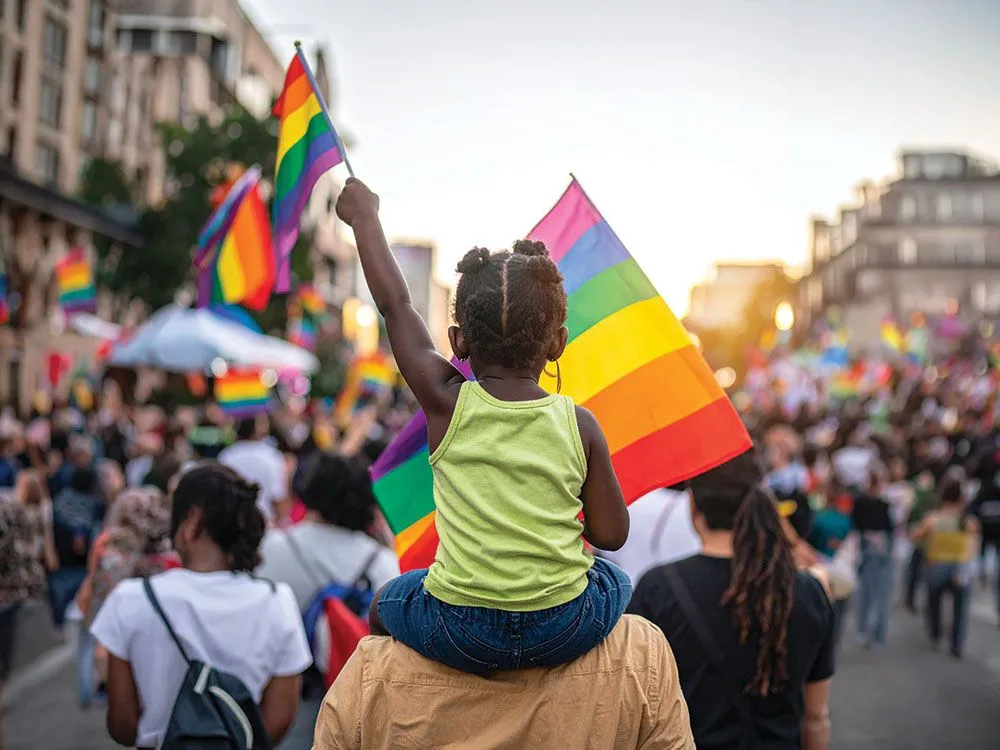
Depending on the age and personality of your children, involve them in a mixture of activities with and without you that will foster their dignity and empowerment. For example, attend meetings, rallies and pride marches together, and/or encourage your children to write to school or local papers. You may even suggest your child attend a support group (see the resource section) to gain peer support in dealing with negative feelings that may arise as a result of negative campaigns. If appropriate, bring your child to volunteer opportunities in the LGBTQ equality movement. Consider attending a social event with your local parenting group, if one exists (check our website), where other LGBTQ families will meet for family-friendly activities, including Family Equality Council events like Family Week and other regional offerings.
Sexuality
Be honest about your own identity and comfort level. Political attacks on our relationships and our parenting may bring up questions or conversations about sexuality and sexual identity. For many parents, talking to their children about sexuality can be uncomfortable and difficult. It is most useful to be honest with your children. If you are uncomfortable, let your children know you find this subject hard to talk about, but that you feel it is important for families to talk about difficult things. In discussing sexuality and sexual identity, listen closely to your child, and when possible, let your children take the lead. Let them ask questions. Take cues about their level of understanding from the questions they ask and interact at that level. Be as clear as you can about your own feelings connected to sexuality, coming out, privacy and family values.
Consider your child’s age and how much information he or she needs. For younger children, simple answers often suffice. Share age-appropriate literature on sexuality and sexual identity with your kids. Organizations such as the Sexuality Information Education Council of the United States have excellent pamphlets that can help you and your children talk about sexuality and sexual identity. It is useful to have information from both gay and straight organizations so that your children can see the issues of sexuality in its full spectrum. For kids who are dealing with negative attitudes about homosexuality, it is sometimes helpful for them to see that organizations that are not exclusively gay often deal with gay issues as a matter of course. This can help children who may have internalized negative messages from our heterosexist society. In addition to print publications, there are now many websites that have excellent information.
Dealing with Hate Speech & Prejudice against Diversity
The best way to teach a child about respect for diversity is to be a role model
Set an example for your child by responding to verbal and non-verbal slurs and prejudice. This will show your child that disrespectful speech and behavior is always unacceptable. Place gay hate speech in the larger context of all discrimination: racial, religious, class, gender, etc. Let your child know that every bias incident violates someone’s sense of safety, respect, and belonging. Foster your child’s sense of dignity by assuring him or her that your family is as authentic as any other family based on core values of love, respect, commitment, belonging and pride. Assure your child that your family is okay. Help them understand that the problem lies with the person or people who discriminate. Discuss the meaning of negative terms your child may hear or use.
Help your children develop their own responses to hate speech and prejudiced attitudes
Ask your children how they might respond to negative comments about gay identity or their family make-up. Role-play and practice appropriate responses to hateful remarks or intolerant incidents. Let them know that though it can be difficult to stand up for themselves or their families in such situations, it gets easier with time and can be empowering. To encourage them, ask them to think about how it makes them feel to not stand up to insensitive or hateful remarks. When appropriate, share your own experience and struggles with your children so that they know they are not alone in feeling uncertain or afraid in difficult situations.
For example, your child might hear something like this from a classmate “My (mom, dad, sister, etc.) says your family is not right.” You may help your child develop a response, such as, “Being different is not wrong. It would be a really boring world if everyone was the same.” If your child comes home with the pain of a classmate having called him or her names because of your family, help him or her understand that any name calling is cruel and has nothing to do with who they are. You could teach your child to respond by saying, “My family does not believe in calling people names,” and instruct your child to walk away.
Foster a critical attitude toward media representations
Make media evaluation a part of your home conversation about your family. In general, help your kids see the ways in which videos, television, music, advertising, books and the Internet influence people’s thinking and behavior. Seek out media resources that carry positive and inclusive messages regarding sexual orientation and families.
Engage your child in relationships and settings that are supportive of our family structure and identify safe people
Cultivate a circle of friends and a community atmosphere that respects and celebrates a range of family configurations. Help your children identify safe people at school and in the community with whom they can talk. Don’t wait for a negative incident to happen to your child; identify safe people ahead of time so that your child has someone to talk to if you are not around. Bear in mind that children may personalize bad things that happen to them and wonder what they did to deserve such bad treatment. If your child does hear negative comments about your family, or if he or she is subject to disrespectful treatment, affirm that the problem lies with the person or people who discriminate. You can also emphasize that no one deserves to be mistreated.
Help your child learn to assess his or her safety in confrontational situations. Stress physical safety first – sometimes leaving a tense situation is the best thing in the moment. Avoid or debunk any suggestions that it’s your fault, or your child’s’ fault, if anything happens. If something does happen, express regret without compromising pride. Let your child know that in complicated areas of human relations having to do with difference, sexuality and discrimination, mistakes, uncertainties and misunderstandings can happen. The key is to find respectful, persistent, creative, kind and honest ways to communicate about difference.
Consider the special vulnerability of children during adolescence
Be aware of the intensified world of adolescence. This can be a particularly hard time for your child in terms of peer pressure and a desire to assert identity and fit in. At this stage of their development, your children may feel particularly sensitive about coming from a family that is “different”. On the other hand, this acute awareness of social status on the part of teenagers can be capitalized upon to help them make respectful decisions about how people should be treated. Help your teens think through issues of injustice and encourage them to develop personal values based on respect for all kinds of people. Often, teens have a natural interest in justice and are well-served by channeling their energies into student organizations or forums, such as peer-education groups or student publications. Encourage your child to join a peer support group, or start a peer education or tolerance group.
Sexual Orientation Issues in Your School, Community and Place of Worship
At school
Talk to your child’s teacher, childcare worker, minister, etc., about the impact these negative attacks are having on your child and the community. Find out if the public institutions your child attends are dealing with these attacks and the issues theymay raise. Ask schools, churches and agencies what kind of training and support is offered on diversity issues and in particular, lesbian, gay, bisexual, transgender and queer issues. Ask about your schools’ health curriculum. Insist that a range of family structures be represented in course materials. Ask how issues of diversity are integrated into the curriculum as a whole. Talk to school counselors and social workers. Request that inclusive literature on families and sexual identity be visible and available in their offices. Contact Family Equality Council for a copy of Opening Doors: Lesbian and Gay Parents and Schools or Opening More Doors: Creating Policy Change to Include Our Families, two publications about how to build positive and nurturing relationships between LGBTQ-headed families and the schools their children attend.
Be aware that school officials often respond differently to anti-gay bias than to other kinds of prejudice. While many schools will not tolerate discrimination based on race, class, gender, etc., they are sometimes less vigilant about enforcing policies that protect students and teachers from discrimination based on sexual orientation and gender identity. In some states, there is legislation protecting LGBTQ students and teachers against such discrimination. But even when such policies exist, they may not protect the children of LGBTQ parents. Find out what your school’s policies are. Ask your school’s administration to develop and distribute policies that honor and celebrate diversity. You may refer to other Family Equality Council publications or contact us directly for guidance on how to go about creating change at your child’s school.
Pay special attention to how initiatives or political attacks are being handled, particularly at the middle school and high school level. Often, well-meaning teachers, wanting to broaden students’ perspectives will engage the class in a debate on these issues. This can lead to very negative experiences for the child of an LGBTQ parent who may be put in a difficult position of defending against personal attacks against his/her family under the guise of arguing a certain side of the argument. If these anti-family initiatives are happening in your community, engage your child’s social studies or current events teacher early to see whether they plan on addressing this issue in their classroom and from what perspective. Being prepared for these types of classroom conversations is one of the best ways to prevent the arguments from becoming damaging.
At Your Place of Worship
Talk to your spiritual leader about ways your congregation can help support families like yours. A newsletter article about the campaign, a sermon about diversity or making sure that all families are included in the religious education curriculum are ways religious communities can help your family. Express your concern for your child’s well-being in light of possible fall-out from these attacks and their related media campaigns. There are many, many wonderful open and affirming religious communities that stand for the inherent dignity and worth of all persons.
Use Your Judgment & Available Resources
Just as each family has its own unique members and traditions, you will have your own special way of dealing with your children. Parents are generally the “expert/s” when it comes to knowing and dealing with their own children.
It is important to stress that you love your child/children and that you are always available to talk to them about these issues. If you are not in the habit of having such talks with your children, don’t try to catch up all at once. The most important thing is to be open and available whenever your child wants to talk.
One of the best resources parents have is other parents. Locate and talk to other LGBTQ parents. Family Equality Council can help you connect with (or start!) a local parenting group. Give your children opportunities to meet and make friends with other children who thrive in lesbian, gay, bisexual, transgender and queer households. You may even find it helpful to attend a support group to discuss with other parents the ways in which they are dealing with issues related to political attacks on our families. Take advantage of resources available to you, and be a resource for others when you can be. Finally, seek professional help with your child if she or he is having difficulties surrounding these types of attacks and the negative implications of treating our families as less valuable, loving or real than other families.
Family Equality Council • PO Box 206 • Boston, MA 02133 • www.familyequality.org